Table of Contents
ToggleWhat Is ESG?
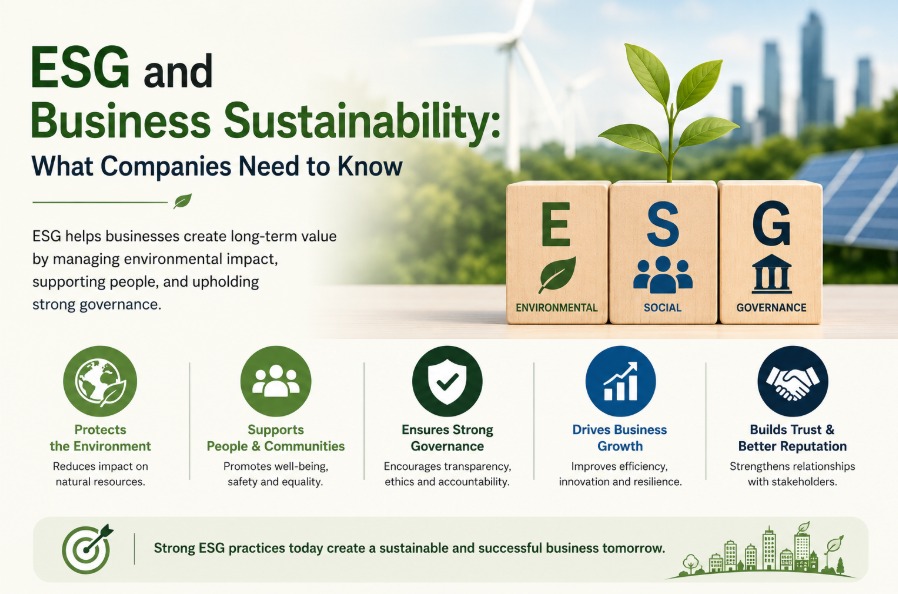
ESG stands for Environmental, Social, and Governance. It is a framework used to evaluate how responsibly a company manages its environmental impact, relationships with stakeholders, and corporate governance practices. ESG has become an important measure of business sustainability because it helps organizations assess risks, improve performance, and demonstrate their commitment to responsible business practices. Today, many investors, regulators, and customers consider ESG factors when evaluating companies.Why Is ESG Becoming Important for Businesses?
Businesses today operate in an environment where sustainability, transparency, and accountability are increasingly important. Customers, investors, regulators, and other stakeholders are paying greater attention to how companies manage environmental and social issues. Growing concerns related to climate change, resource management, corporate ethics, and social responsibility have made ESG a key business priority. Companies that proactively address ESG issues are often better positioned to manage risks and create long-term value.Understanding the Three Pillars of ESG
The Environmental component focuses on how a company manages its impact on the environment. This may include energy consumption, greenhouse gas emissions, waste management, water conservation, pollution prevention, and resource efficiency. The Social component examines how a company interacts with employees, customers, suppliers, and communities. Key areas include workplace safety, employee welfare, diversity and inclusion, human rights, and community engagement. The Governance component focuses on corporate leadership, ethics, transparency, compliance, risk management, and decision-making processes. Strong governance helps ensure accountability and responsible business conduct.How Does ESG Support Business Sustainability?
Business sustainability involves creating long-term value while managing environmental, social, and economic impacts responsibly. ESG provides a structured framework that helps companies integrate sustainability into their operations and decision-making processes. By addressing ESG factors, businesses can improve resource efficiency, strengthen stakeholder trust, reduce operational risks, and build resilience against future environmental and social challenges. ESG therefore serves as a foundation for sustainable business growth.What Are the Benefits of ESG for Companies?
Implementing ESG practices can provide numerous advantages for businesses. Companies with strong ESG performance often benefit from improved brand reputation, increased customer trust, stronger investor confidence, and better stakeholder relationships. ESG initiatives can also help reduce operational costs through energy efficiency, waste reduction, and resource optimization. In addition, businesses that prioritize ESG are often better prepared to comply with evolving regulations and sustainability expectations.What Challenges Do Businesses Face in ESG Implementation?
Despite its benefits, ESG implementation can present several challenges. Many organizations struggle with collecting reliable ESG data, measuring performance, and establishing meaningful sustainability targets. Businesses may also face difficulties related to reporting requirements, resource constraints, limited expertise, and changing regulatory expectations. Developing effective ESG strategies often requires long-term commitment and continuous improvement.How Can Companies Improve Their ESG Performance?
Companies can improve ESG performance by establishing clear sustainability goals, monitoring environmental impacts, reducing waste generation, improving energy efficiency, and promoting responsible business practices throughout their operations. Organizations can also strengthen ESG performance through employee engagement, transparent reporting, stakeholder communication, ethical governance practices, and investments in sustainable technologies. Continuous monitoring and improvement are essential for long-term success.Why Is ESG Important for Investors and Stakeholders?
Investors increasingly use ESG information to assess the long-term risks and opportunities associated with a business. Strong ESG performance can indicate effective risk management, responsible leadership, and sustainable growth potential. Customers, employees, suppliers, and communities are also paying closer attention to corporate sustainability practices. Companies that demonstrate strong ESG performance often build greater trust and stronger relationships with stakeholders.Conclusion
ESG has evolved from a voluntary sustainability concept into an important business framework that influences corporate performance, investment decisions, and stakeholder expectations. By focusing on environmental responsibility, social impact, and good governance, companies can create long-term value while managing risks effectively. As sustainability continues to shape the future of business, ESG will play an increasingly important role in helping organizations improve resilience, strengthen stakeholder trust, and support sustainable development goals.Frequently Asked Questions (FAQs)
1. What Does ESG Stand For?
ESG stands for Environmental, Social, and Governance. These three pillars are used to evaluate a company's sustainability performance and responsible business practices.
2. What Is the Difference Between ESG and Sustainability?
Sustainability is a broad concept focused on long-term environmental, social, and economic well-being. ESG provides a measurable framework that businesses use to assess and report sustainability performance.
3. What Are ESG Goals?
ESG goals are targets established by organizations to improve environmental performance, social responsibility, and governance standards over time.
4. How Can Companies Improve ESG Performance?
Companies can improve ESG performance through sustainability initiatives, transparent reporting, energy conservation, waste reduction, stakeholder engagement, and strong governance practices.
5. What Is the Future of ESG?
The future of ESG is expected to involve greater transparency, stronger sustainability reporting, increased investor focus, and wider adoption of responsible business practices across industries.