Table of Contents
ToggleWhat is the Polluter Pays Principle?
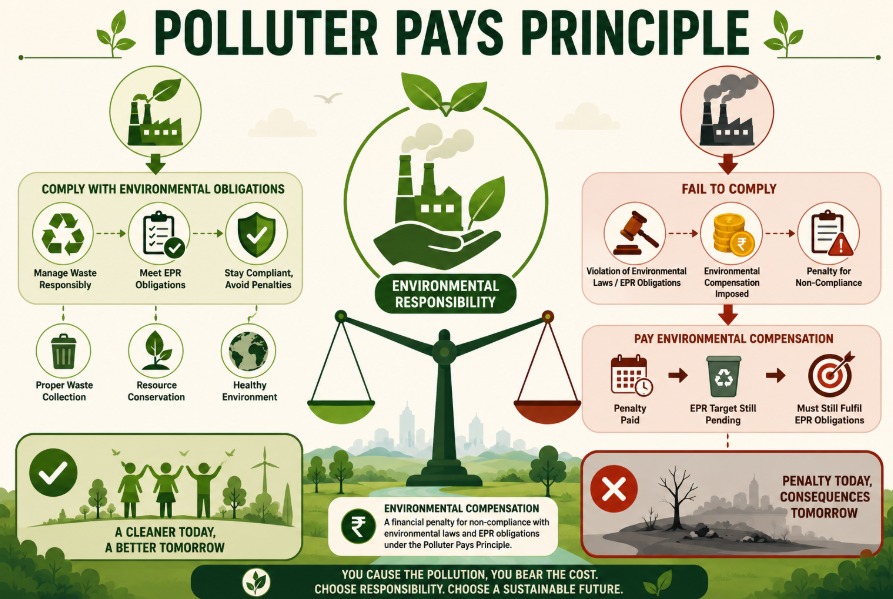
The Polluter Pays Principle is an environmental principle that requires businesses or entities responsible for causing pollution, environmental damage, or regulatory violations to bear the cost of addressing their impact. It serves as the foundation for Environmental Compensation, ensuring that the financial burden of environmental harm is not transferred to society but remains with the party responsible for the violation. Under various environmental regulations in India, this principle is applied when businesses fail to meet EPR targets, violate waste management rules, operate without required approvals, or engage in improper waste handling practices.Why was the Polluter Pays Principle Introduced?
The Polluter Pays Principle was introduced to ensure that businesses and entities responsible for environmental damage are held accountable for their actions. Instead of placing the burden of environmental restoration and waste management on the government or society, the principle requires the polluting entity to bear the financial and regulatory consequences of non-compliance. The principle also encourages businesses to adopt environmentally responsible practices, improve waste management systems, and comply with environmental regulations. By imposing Environmental Compensation and other enforcement measures, it helps reduce pollution, strengthen regulatory compliance, and promote sustainable environmental management across different sectors.What is Environmental Compensation?
Environmental Compensation is a financial penalty imposed on businesses or entities that fail to comply with environmental regulations, waste management rules, pollution control requirements, or assigned EPR obligations. It is one of the primary enforcement mechanisms used by environmental authorities to address non-compliance and ensure accountability. Environmental Compensation is based on the Polluter Pays Principle, which states that the entity responsible for causing environmental harm or violating environmental requirements must bear the cost of its actions. However, payment of Environmental Compensation does not replace the original compliance obligation. Businesses are still required to fulfil pending targets, correct violations, and comply with the applicable environmental regulations.Which Authorities Can Levy Environmental Compensation?
Environmental Compensation may be levied by regulatory authorities such as the Central Pollution Control Board (CPCB), State Pollution Control Boards (SPCBs), Pollution Control Committees (PCCs), and other competent authorities responsible for monitoring environmental compliance. The authority responsible for imposing compensation may vary depending on the applicable environmental regulation, waste management framework, and nature of the violation. These authorities assess instances of non-compliance, determine the extent of the violation, and impose Environmental Compensation in accordance with the Polluter Pays Principle. They also monitor corrective actions and ensure that businesses fulfil their pending environmental obligations in addition to paying the compensation.Does Paying Environmental Compensation Remove Compliance Obligations?
No. Paying Environmental Compensation does not remove or replace a business’s original environmental obligations. One of the most common misconceptions is that once a penalty is paid, the compliance requirement is considered fulfilled. However, under the Polluter Pays Principle, Environmental Compensation is a consequence of non-compliance, not an alternative to compliance. Businesses are still required to fulfil pending EPR targets, correct regulatory violations, and comply with the applicable environmental requirements even after paying compensation. In many cases, unfulfilled obligations are carried forward to future compliance periods, and continued failure to meet these obligations may result in additional penalties, stricter enforcement actions, or suspension of registrations.Why Are EPR Targets Still Required After Paying Compensation?
EPR targets remain mandatory even after Environmental Compensation is paid because the compensation is intended to address the violation, not to replace the original compliance obligation. The objective of EPR regulations is to ensure that waste is actually collected, recycled, refurbished, or processed through authorized channels. Simply paying a penalty does not achieve these environmental outcomes. Therefore, businesses are still required to fulfil their pending EPR targets within the prescribed timelines. The principle simply states that paying compensation addresses the non-compliance, while fulfilling the target addresses the environmental responsibility.How Does the Refund Mechanism Work Under Certain EPR Frameworks?
Certain EPR frameworks provide a refund mechanism to encourage businesses to fulfil their pending obligations even after Environmental Compensation has been imposed. If a business subsequently meets its outstanding EPR targets within the prescribed timeframe, a portion of the Environmental Compensation may be refunded according to the applicable rules. The refund percentage generally decreases over time, encouraging businesses to address compliance shortfalls as early as possible. However, if the pending obligations are not fulfilled within the specified period, the compensation amount may be forfeited and utilized for environmental management and waste processing activities.Why is EPR Compliance More Effective Than Paying Environmental Compensation?
EPR compliance is generally more beneficial than paying Environmental Compensation because it helps businesses fulfil their assigned recycling targets while remaining compliant with environmental regulations. In certain frameworks, such as the Battery Waste Management Rules, the trading price of EPR Certificates is linked to Environmental Compensation, making compliance a more practical and cost-effective approach. Environmental Compensation is a penalty for failing to meet EPR obligations and does not replace the original target. Even after paying the compensation, businesses may still be required to fulfil the pending obligation within the prescribed timelines. Therefore, achieving compliance through EPR Certificates not only supports responsible waste management but also helps businesses avoid additional liabilities and regulatory risks.Conclusion
EPR Certificates play an important role in modern waste management systems by helping businesses fulfil their environmental responsibilities through verified recycling, recovery, refurbishment, and waste processing activities. s. As EPR frameworks continue to evolve across different waste streams, understanding and effectively managing EPR Certificates has become essential for businesses seeking to achieve compliance, avoid regulatory risks, and contribute to environmentally responsible waste management practices. For businesses seeking assistance with EPR registration, EPR target fulfilment, documentation, certificate management, and compliance reporting, Axis Consultants provides professional support for end-to-end environmental compliance requirements.Frequently Asked Questions (FAQs)
1. What happens if a business repeatedly violates the rules?
If a company commits repeated offences, such as providing false information three or more times, authorities have the power to permanently revoke or cancel their business registration.
2. How is the Environmental Compensation amount determined?
The specific penalty amount levied is generally based on the rules violated and the extent of the environmental damage caused by the non-compliance or improper disposal.
3. Is Environmental Compensation only charged for missing EPR targets?
No, it is also strictly levied for operating without proper registration, submitting forged documents, providing false information, or handling waste unscientifically
4. What happens to the money collected as Environmental Compensation?
The collected penalty funds are kept in a separate escrow account managed by the government. This money is then actively utilised to fund authorised waste management activities, such as recycling, processing, and clearing legacy waste dumpsites.
5. Does paying Environmental Compensation cancel my EPR obligations?
No, paying the penalty does not absolve a producer from fulfilling their assigned EPR recycling targets. The unfulfilled targets are simply carried forward to the following years and must still be completed.